A remodeling marketing plan is usually written as a list of channels. Fix the website, do some SEO, run Google Ads, post on social, send a newsletter. That is a to-do list. It tells you what to be busy with. It doesn’t tell you how many jobs the work should produce, what it should cost, or what to do first.
A remodeling marketing plan is defined as: a one-page answer to four questions. How many jobs do you need, where will the leads come from, what will that cost, and what gets fixed first?
This post walks through the six steps to build one for 2027 from your own numbers. At the end there is a one-page template to fill in.
Why most remodeling marketing plans never get used
Most marketing plans fail for the same three reasons.
There is no number. “More leads” is a wish. A plan needs a count of signed jobs and a date.
There are too many channels. Ten things get started, each one gets a fifth of the attention it needs, and all of it is run by an owner who is also running jobs.
There is no order. Everything starts in the same month, so nothing gets finished.
You would never run a kitchen that way. You set the scope, price it, and schedule the trades in sequence. A marketing plan for remodelers should work the same way: scope, budget, sequence.
Step 1: Start with signed jobs and work backward
Decide how many signed jobs you want from new leads over the next 12 months. Count jobs, not revenue, and count every source: ads, referrals, and people who found you on their own.
Then walk that number backward through your remodeling marketing funnel, using your own results from the last 90 days: leads, booked estimates, proposals sent, and jobs signed.
Here is a made-up example. Say the last 90 days produced 60 leads, 21 booked estimates, 15 proposals, and 4 signed jobs. That pace is 16 jobs a year. The goal is 24 signed jobs next year, which is 2 a month. At an average job of $50,000, that is $1.2 million in new work.
- 24 signed jobs take 90 proposals, because 4 of every 15 proposals get signed.
- 90 proposals take 126 estimates, because 15 of every 21 estimates end in a proposal.
- 126 estimates take 360 leads, because 21 of every 60 leads book an estimate.
That works out to 30 leads a month, up from the 20 a month coming in now. It is the first line of the marketing plan: 30 leads a month to sign 2 jobs a month.
If you can’t produce those four numbers, that is your first task, and nothing else in the plan can be trusted until it is done. Your consultation close rate is the place to start.
Step 2: Fix the leaks before you buy more leads
There are two ways to reach 24 jobs. You can buy more leads, or you can lose fewer of the ones you already get. The second is nearly always cheaper.
Stay with the example. Suppose you sign 5 of every 15 proposals instead of 4. That is one extra signature in every 15 proposals. Now 24 jobs take 72 proposals, about 101 estimates, and about 288 leads. That is 24 leads a month, down from 30.
One small improvement cut the leads you have to pay for by 20%, every month, for as long as it holds.
I call this problem the Leaky Bucket: real projects come in and disappear before a contract. The usual places to look:
- How fast a new lead gets an answer. A Harvard Business Review study of online sales leads found that companies responding within an hour were nearly seven times as likely to qualify the lead as those that waited even an hour longer.
- Calls that go to voicemail while you are on a job site. A missed-call text-back covers this cheaply.
- How many days a proposal takes to go out.
- What happens after the proposal. Most homeowners who say “not now” are not saying no, so a follow-up system for “not now” leads earns its keep.
Pick the biggest leak and write it into the plan as the first thing to fix. Paying for more leads while this is broken means losing more leads the same way.
Step 3: Choose one engine and two supports
You don’t need ten channels. You need three jobs covered.
The engine is a lead source you can turn up or down. For most remodelers selling larger projects, that is paid search: Google Ads and Local Services Ads reaching a homeowner at the moment they look for a remodeler. It costs money every month and it stops when you stop paying. In return, it is the one source where you decide the volume. The guide to Google Ads for remodeling businesses covers how it works.
The first support is something that compounds. Your Google Business Profile, a steady flow of reviews, and service pages that rank in your area. It is slow, it costs little, and it keeps paying after the work is done. Start with local SEO for remodeling businesses and how to get Google reviews.
The second support keeps you in front of people you have already met. Past clients, trade partners, and the homeowners who got an estimate and went quiet. A referral program and a simple email every month or so do this job.
Social posting, video, and retargeting ads can all help. Leave them out of the marketing plan until the engine and both supports run without you thinking about them.
If the budget for ads isn’t there yet, make referrals your engine for now. Referrals can’t be turned up on demand, so treat that as temporary and write down the date the ad budget starts.
Step 4: Set the budget from the math
Most budget advice starts with a percentage of revenue. I’d start with the leads you need, because that number came from your own business.
Take the monthly lead count from Step 1, or from Step 2 once the fix is holding. Write down how many of those leads your free sources already bring in. The rest have to come from the engine, and that count multiplied by your own cost per lead is your ad budget.
Back to the example, with made-up figures again. Say the fix from Step 2 is holding, so the plan needs 24 leads a month. Referrals and the Google Business Profile have been bringing in 9 of the current 20. Ads have to produce the other 15, up from 11. If leads from your ad account cost $180 each over the last 90 days, the ad budget is $2,700 a month.
Three cautions:
- Leads from different sources don’t convert the same way. A referral usually closes more easily than a click. Once you have numbers by source, redo the math for each one.
- Count the management, too. Your hours or an agency’s fee belong in the cost of a signed job, next to the ad spend.
- No history means the first 90 days of ads are a test. Set a fixed amount you can afford to learn with, and judge it at the end of the period, not week by week.
There is more on sizing the spend in the right Google Ads budget for a remodeling business.
Step 5: Decide what you will look at every month
A marketing plan nobody checks is a document. Choose the numbers now, before the money is spent.
For each lead source, count four things: leads, booked estimates, proposals sent, and signed jobs. Add what you spent. From those you get the two numbers that matter:
- Cost per booked estimate. This tells you whether the source is finding the right homeowners.
- Cost per signed job. This tells you whether it is worth the money.
A spreadsheet updated on the first of the month is enough. The setup is covered in how to track remodeling marketing ROI.
One more piece belongs here if you run ads. Google lets you send sales outcomes back into the ad account, so the ads learn which leads became estimates and jobs. Without it, the account only learns who fills in forms.
Step 6: Put the work in order, 90 days at a time
This is the part most plans skip. Give each quarter one main job.
- First 90 days: see and stop the leaks. Get the four numbers by source. Fix the biggest leak from Step 2. Add no new channels.
- Next 90 days: build or repair the engine. Tracking first, then campaigns split by project type, then a landing page that converts for each one.
- Next 90 days: add the support that compounds. Reviews, your Google Business Profile, and service pages.
- Last 90 days: add the keep-in-touch support, then redo Step 1 with a year of real numbers.
Keep each quarter to three priorities at most, each with a name and a date next to it. If the owner is the name next to all three, cut one.
Plan for timing as well. Homeowners often start researching months before they want work to begin, so the jobs you want to start in spring come from leads you pay for in winter. I wrote about the slow months in how to get remodeling leads in the off-season.
The one-page remodeling marketing plan template
Here is the whole marketing plan on a page. Fill in the blanks.
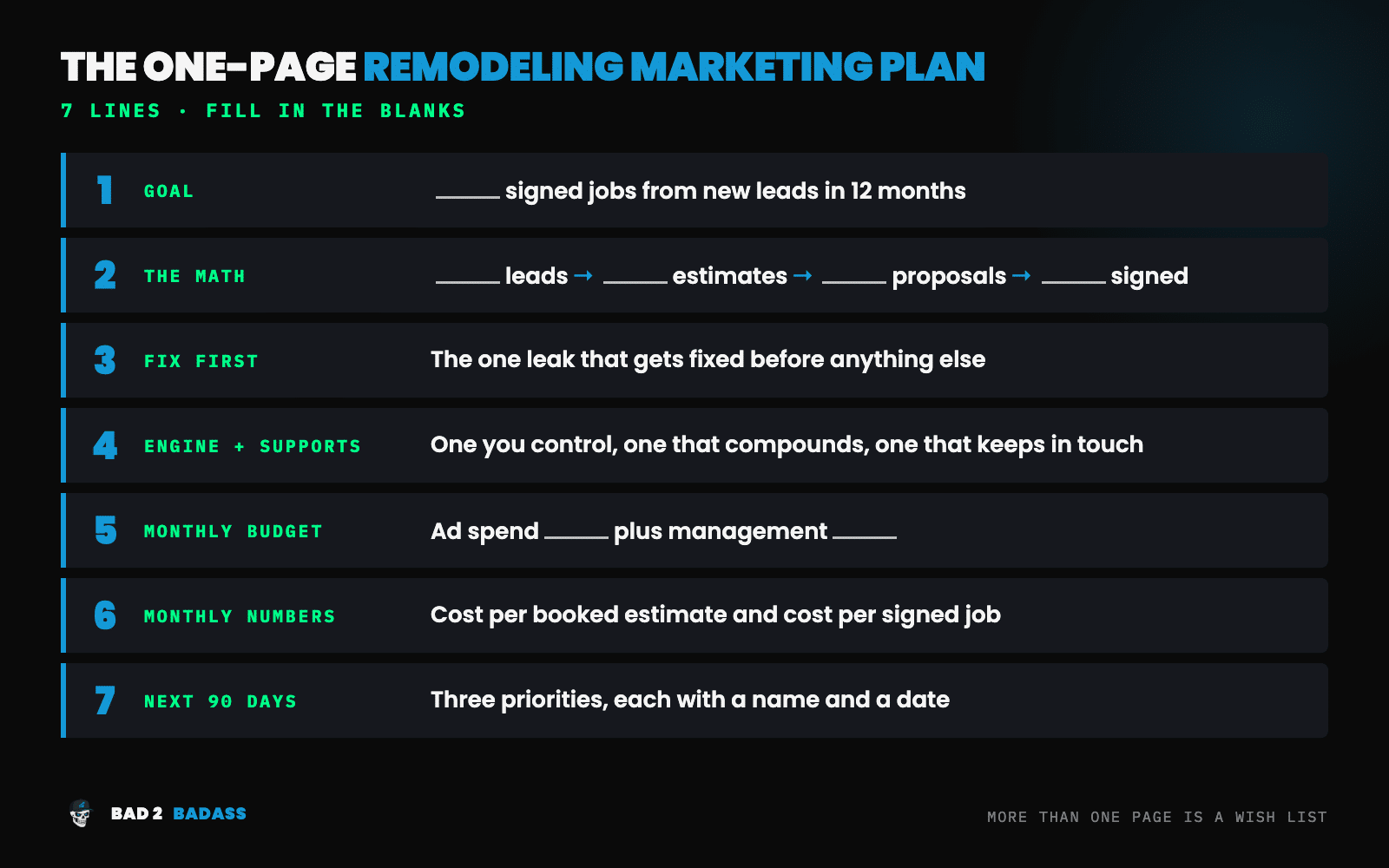
- Goal: ___ signed jobs from new leads in the next 12 months
- The math: ___ leads, ___ estimates, ___ proposals, ___ signed jobs per month
- Fix first: the one leak that gets fixed before anything else
- Engine and supports: one source you control, one that compounds, one that keeps you in touch
- Monthly budget: ad spend ___, plus management ___
- Monthly numbers: cost per booked estimate and cost per signed job, by source
- Next 90 days: three priorities, each with a name and a date
If it doesn’t fit on one page, it is a wish list, and it will be treated like one.
What to leave out of your marketing plan
What you remove matters as much as what you add.
- Any channel nobody owns. If there is no name next to it, it will not happen.
- Any number that is not on the path to a signed job. Impressions, followers, and clicks can explain a result. They are not the result.
- Anything you are doing only because a competitor does it. You can’t see their numbers.
- A fourth priority. Three per quarter is the limit for a company where the owner still sells.
Wrapping it all up
A remodeling marketing plan is not a list of everything you could do. It is a short list of what you will do, in order, with a number attached.
To recap the six steps:
- Start with signed jobs and work backward to leads.
- Fix the leaks before you buy more leads.
- Choose one engine and two supports.
- Set the budget from the math.
- Decide what you will look at every month.
- Put the work in order, 90 days at a time.
Start with the first two. They cost little or nothing, and they change every number that comes after them.
Want to know what your remodeling marketing plan should fix first?
I do one piece of this plan. I run paid search (Google Ads and Microsoft Ads) for remodeling companies selling $20K+ projects. I don’t do SEO, social media, or email, so that part of the plan stays with you or with someone else.
Every engagement starts with the BAD-ectomy™, a $297 diagnosis delivered in 5 business days. It looks at your paid search and at what happens to those leads afterward. You get the three biggest things holding back growth, a map of where opportunities are leaking, and a 90-day plan for what to fix first. Nothing in your account gets changed, and the findings are yours whether or not we work together.
Not ready for that? Book a discovery call.