A remodeling marketing budget usually gets set one of two ways. It is last year’s number plus a little, or it is a percentage of revenue that somebody quoted. Neither one tells you what the money is supposed to produce.
This post builds your 2027 budget the other way around. You start with the signed jobs you want, work back to the leads you have to pay for, and then add every other cost that marketing carries. There are five steps. At the end you have a monthly number with six lines in it, rules for testing, and rules for moving money.
I use one made-up example all the way through, so you can see how each number leads to the next.
Why a remodeling marketing budget shouldn’t start with a percentage
Most budget advice opens with a percentage of revenue. Pick 5%, 8%, or 10%, multiply, and you are done.
The first problem is where those percentages come from. You will often see 7% to 8% of revenue credited to the U.S. Small Business Administration. The SBA’s own marketing and sales guide doesn’t give a percentage. It says to include a complete breakdown of what your marketing plan will cost.
The most detailed public numbers I know of on remodelers’ finances come from the National Association of Home Builders. Its 2026 Remodelers’ Cost of Doing Business Study reports that operating expenses averaged 23.6% of revenue in fiscal 2024. That figure lumps sales and marketing in with finance, general and administrative costs, indirect construction costs, and the owner’s pay. The published summary doesn’t break marketing out on its own.
The second problem is that a percentage knows nothing about your company. It doesn’t know how many leads reach you for free, what a paid lead costs in your market, or how many estimates you turn into contracts.
A percentage is still worth having as a result. Once the budget is built, divide it by the revenue it is meant to produce, and watch that figure from year to year.
Step 1: Count the leads you have to pay for
The budget starts with a count of signed jobs. I walked through that math in the remodeling marketing plan post, and I’ll use the same made-up company here so the two posts agree.
The company wants 24 signed jobs from new leads over the next 12 months. That is 2 a month. At an average job of $50,000, it is $1.2 million in new work.
Its last 90 days produced 60 leads, 21 booked estimates, 15 proposals, and 4 signed jobs. The plan also assumes one fix: signing 5 of every 15 proposals instead of 4. With that fix holding, 24 signed jobs a year take 24 leads a month.
Now split that count in two:
- Leads that arrive for free. Referrals and the Google Business Profile have been bringing in 9 a month.
- Leads you have to pay for. The other 15 have to come from ads.
Leads from the ad account cost $180 each over the last 90 days. So the ad spend is 15 times $180, which is $2,700 a month.
Use your own numbers here. If you can’t produce them yet, the 20-minute check in the remodeling marketing funnel post shows which four to pull.
If you have never run ads, you have no cost per lead to multiply. In that case the first 90 days are a test. Set a fixed amount you can afford to learn with, and build the budget properly once you have real numbers. There is more on sizing that amount in the right Google Ads budget for a remodeling business.
Step 2: List every line that belongs in the marketing budget
Ad spend is the line everybody remembers. A full marketing budget has six.
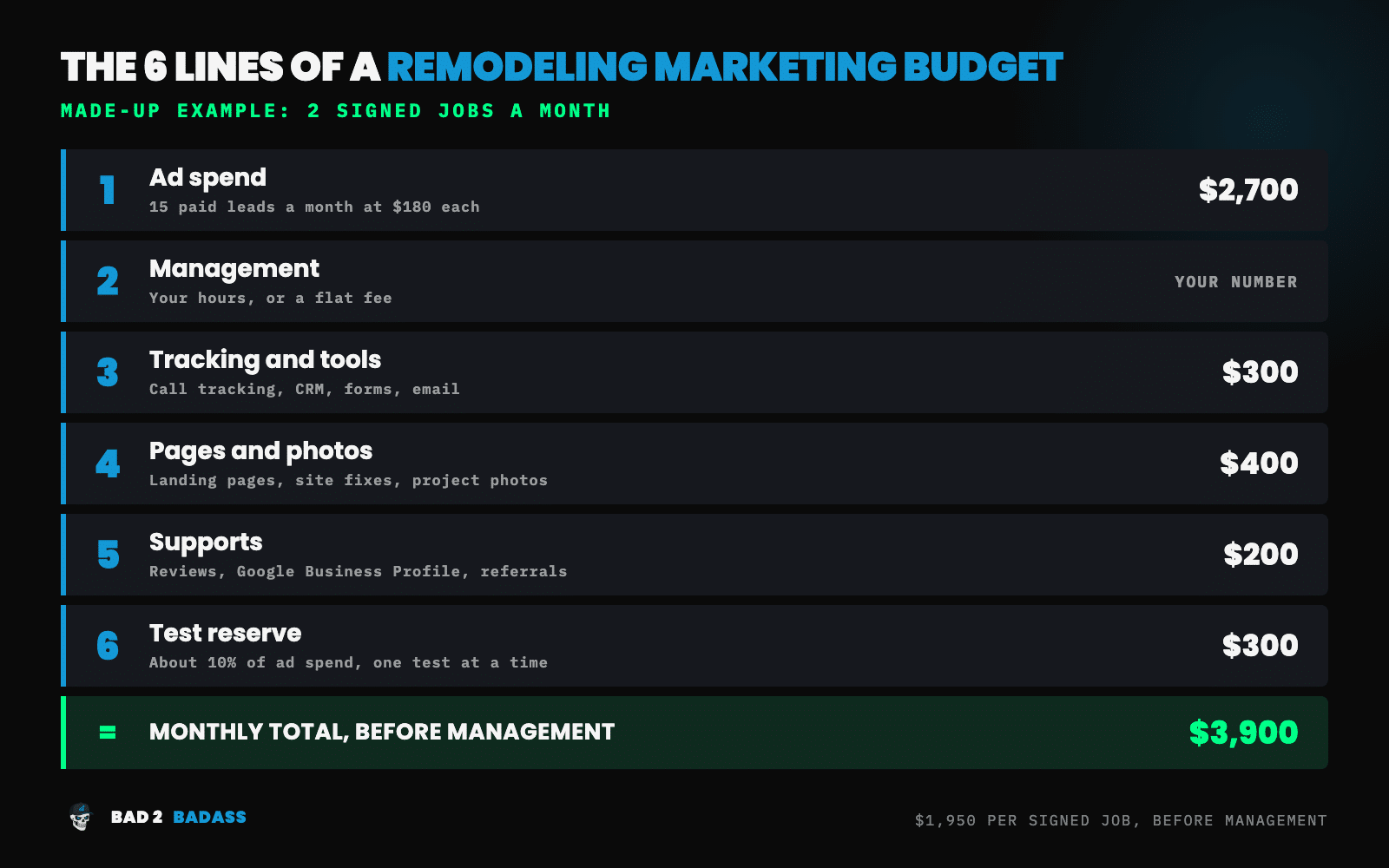
- Ad spend. What you pay Google or Microsoft for clicks and leads. This is the number from Step 1.
- Management. The person who runs the ads and watches the numbers. That is your hours, an employee’s hours, or an agency’s fee.
- Tracking and tools. Call tracking, the CRM or job tracker, and form or email software.
- Pages and photos. Landing pages, website fixes, and photography of finished projects.
- Supports. The slow, low-cost sources: review requests, your Google Business Profile, referral thank-yous, and a monthly email to past clients.
- Test reserve. Money held back to try one new thing at a time. Step 4 covers it.
Here is the example with made-up figures. Ad spend is $2,700. Tracking and tools are $300. Pages and photos are $400, which is a yearly amount for photography and page work spread over 12 months. Supports are $200. The test reserve is $300. That comes to $3,900 a month before management.
I left management blank on purpose. It varies too much for a made-up figure to help. Put your own number in, even if the person doing the work is you. I call this the Owner Bottleneck: everything runs through the owner, so marketing gets whatever hours are left after the jobs. Writing the hours down is how you find out whether the plan depends on time you don’t have.
Now check the total against what a job earns. In the example, $3,900 a month for 2 signed jobs is $1,950 per signed job before management. Against $100,000 a month in new work, that is 3.9% of revenue. This is the percentage worth tracking, because it came out of your own numbers.
Marketing gets paid out of gross profit, along with the rest of your overhead and your own pay. The same NAHB study put remodelers’ average gross profit margin at 29.9%. At that average, a $50,000 job leaves about $15,000 of gross profit to cover all of that, and what remains is your profit. Your margin will differ, so use your own. I wrote more about that study in what the NAHB profit margin data means for remodelers.
Step 3: Fund one lead source fully, then split what is left
The old way to split a marketing budget is to hand each channel a share. I’d fund the lines in order instead.
- Ad spend first, at the full number from Step 1. Half the ad spend buys about half the leads, and then the plan misses.
- Tracking second. Without it you can’t tell which lead became which job, and Step 5 has nothing to work with. Start with call tracking for your remodeling business.
- Pages and photos third. A landing page that converts makes the same ad spend produce more leads.
- Supports last. They need a little money and somebody’s steady attention.
Management isn’t in that order because somebody has to run the ads from the first dollar. The test reserve comes after all four, and Step 4 explains why.
Keep the ad spend in one place until it works. Splitting $2,700 across three platforms gives you three small accounts, and none of them collects enough leads to judge.
Inside the ad account, split the money by project type. Each project type you advertise gets its own campaign and its own budget. Then you can see what a booked estimate costs for each one and put more behind the projects you want. If the ad spend is small, advertise fewer project types so each campaign has enough behind it.
Google asks for an average daily budget on each campaign. Divide the monthly figure by 30.4. In the example, $2,700 a month is about $89 a day across all campaigns. Google says a campaign can spend up to twice its average daily budget on a given day, and no more than 30.4 times that budget over the month. One heavy day is normal.
If Local Services Ads are part of your ad spend, they work differently. You set an average weekly budget and pay per lead.
The budget is a yearly number, and the months don’t have to match. If you want more work starting in spring, the leads for it get paid for in winter. Decide the monthly amounts now. A slow week is the wrong time to make that call.
Step 4: Hold back a test reserve
The $2,700 in the example is already spoken for. It is what the plan needs to reach 24 leads a month. If you test something new with that money, you buy fewer of the leads the plan depends on.
So tests get their own line. I’d start at about 10% of ad spend, added on top. In the example I rounded that up to $300 a month, or $900 a quarter.
Things worth testing, one at a time:
- A campaign for a project type you have not advertised before
- Local Services Ads, if you are not running them
- Microsoft Ads, with the keywords and ads that already work on Google
- A new landing page against the current one. Google Ads has an experiments feature that splits traffic between the original campaign and the test, so you compare the two over the same period
Four rules keep a test honest:
- One test at a time. Two at once and you can’t tell which one moved the numbers.
- Write the pass mark first. Use cost per booked estimate, and compare it with what your main campaigns produce.
- Set an amount and an end date. When either runs out, the test is over.
- Unused reserve rolls forward. It doesn’t get folded into regular ad spend.
Be realistic about what $900 can show. It will not prove anything about signed jobs. It will show whether the right homeowners respond and roughly what a lead costs, which is enough to decide whether the idea gets a real line next quarter.
If you are in your first 90 days of ads, skip the reserve. The whole ad spend is the test.
Step 5: Review the budget every month and move money on a rule
A budget only works if somebody checks it. Put a review on the calendar for the first week of every month.
For each lead source, write down what you spent, then count leads, booked estimates, proposals, and signed jobs. Two numbers come out of that: cost per booked estimate and cost per signed job. The spreadsheet for it is covered in how to track remodeling marketing ROI.
Then compare each of the six lines with what you planned to spend, and decide whether each one holds, goes up, or comes down. These are the rules I’d use:
- Judge on 90 days. On large projects the signature can come weeks or months after the lead. This month’s ad spend and this month’s signed jobs are mostly different homeowners.
- Read cost per booked estimate first. It moves sooner than cost per signed job. A source with cheap leads and few booked estimates is charging you the Tire Kicker Tax: you pay for the lead, then you pay again in time.
- Move money in steps. Two small changes a month apart tell you what each one did. One large change doesn’t.
- Fix before you add. If cost per lead is climbing, raising the budget buys more of the same. Work through ways to lower your cost per lead first.
- Redo Step 1 every quarter. Your cost per lead and your close rate will change, and the ad spend should follow them.
What to do when the remodeling marketing budget comes out too high
Sometimes the total is more than the business can carry. Don’t trim every line by the same amount. That leaves all six too thin to work. Try these in order.
Lose fewer of the leads you already get. I call this problem the Leaky Bucket: good leads come in and disappear before a contract. In the example, signing 5 of every 15 proposals instead of 4 took the plan from 30 leads a month to 24. Six fewer paid leads at $180 each is $1,080 a month that never has to be spent. Start with your consultation close rate.
Move the date. Reaching 24 jobs in 18 months costs less each month than reaching it in 12.
Narrow the ads. Advertise one project type in a smaller service area. A narrow campaign with enough money behind it does more than a wide one with too little.
Whatever you cut, keep the tracking. Without it you can’t tell whether the cuts worked.
Wrapping it all up
A remodeling marketing budget is a short list of costs, each tied to the number of signed jobs you want. The percentage of revenue comes last. It is the total divided by the new work it is meant to bring in.
To recap, the 5 steps to build your marketing budget are:
- Count the leads you have to pay for.
- List every line that belongs in the budget.
- Fund one lead source fully, then split what is left.
- Hold back a test reserve.
- Review the budget every month and move money on a rule.
Start with Step 1. Every other line depends on that number.
Is the biggest line in your remodeling marketing budget earning its place?
I work on one line of this budget. I run paid search (Google Ads and Microsoft Ads) for remodeling companies selling $20K+ projects. I don’t do SEO, social media, email, or websites, so those lines stay with you or with someone else.
Every engagement starts with the BAD-ectomy™, a $297 diagnosis delivered in 5 business days. It looks at your paid search and at what happens to those leads afterward. You get the three biggest things holding back growth, a map of where opportunities are leaking, and a 90-day plan for what to fix first. Nothing in your account gets changed, and the findings are yours whether or not we work together.
Not ready for that? Book a discovery call.