Hiring a marketing agency for remodeling business growth is one of the bigger bets an owner makes, and most of the damage is done before the contract is signed. The pitch goes well and the price seems fair. Six months later you have a stack of reports, a lighter bank account, and no clear idea which part of it turned into jobs.
I run a marketing agency myself, so read this with that in mind. Every check below is one you should run on me too. None of them takes marketing knowledge. Each one is a question you can ask on a sales call, and the answer tells you most of what you need to know.
Here are the 7 mistakes I see remodelers make when hiring a marketing agency, and what to ask instead.
Mistake 1: Never finding out who will run your account
The person who sells you is often not the person who does the work. At many agencies the pitch comes from a founder or a senior strategist, and the account then goes to whoever has room. That is frequently the newest person on the team.
It matters more in remodeling than in most businesses. A loose keyword setting can put a good share of your budget into faucet repairs and handyman calls when you sell $60K kitchens. Catching that early takes someone who has seen it before.
Ask: “Who will be in my account each week, and can I meet them before I sign?” If you get a job title and not a name, you have your answer.
I wrote more about this in what happens when a junior account manager runs your remodeling marketing, and about the tradeoff from the other side in why my remodeling agency stays small.
Mistake 2: Taking “we work with contractors” as experience
Plenty of agencies list contractors, home services, or “local businesses” on their website. That covers a plumber selling a $300 service call and a design-build firm selling a $150K addition. The marketing for those two has very little in common.
A remodeling sale is slow and expensive on both sides. The homeowner researches, collects several bids, and often waits months before deciding. You spend a drive, an hour at the kitchen table, and an evening on every proposal. A marketing agency that understands this builds campaigns to keep small jobs out. One that doesn’t builds them to pile up cheap leads.
Case studies help, and you should ask for them. But a logo and a percentage are easy to produce. The better test is detail.
Ask: “Walk me through a remodeling or high-ticket account you ran. What did you change first, why, and what happened?” Someone who did the work can answer for ten minutes without notes. Someone who didn’t will talk about “strategy.”
I’m held to the same test. I’ve run paid search for remodeling companies as a freelancer, and that work is under NDA, so I can’t name the companies or show you their numbers. What I can do is tell you what I did and why. If I couldn’t, you’d be right to walk.
Mistake 3: Paying a fee that grows when your ad spend grows
A common setup is a fee set as a percentage of what you spend on ads. It sounds fair, because the agency “only makes more when you grow.”
Look at what it actually rewards. Say the fee is 15% of spend. Raising your budget from $5,000 to $8,000 a month takes the fee from $750 to $1,200, whether or not the extra $3,000 produces a single job. The agency gets a raise for spending more, and the advice you get about your budget comes from someone with a stake in the answer.
Sometimes spending more is the right call. You just want to hear it from someone who isn’t paid more for saying it.
Ask: “How is your fee set, and does it change if my ad budget changes?” A flat fee tied to the work is the cleanest answer. It isn’t automatically honest either, so follow up with what is included and what costs extra. If you’re not sure what the budget itself should be, start with the right Google Ads budget for a remodeling business.
Mistake 4: Believing a number promised before anyone has opened your account
“We’ll get you 40 leads a month.” “You’ll double your jobs in 90 days.” It is what every owner wants to hear, and it is usually said on the first call, before the marketing agency has seen your ad account, your website, or how your phone gets answered.
Nobody can know that number yet. Results depend on things the agency hasn’t looked at and things it will never control: what a click costs in your market, whether your tracking works, how fast calls get returned, and whether the homeowner signs at the kitchen table.
Guarantees deserve the same look. Read what is being guaranteed. It is almost always leads, and leads are the easiest number in marketing to inflate. A guarantee of 40 leads can be met with 40 people pricing a faucet swap.
Ask: “What do you need to look at before you can tell me what to expect?” A good answer names specifics: the account, the search terms, the tracking, what happens after a lead comes in. It usually means some kind of audit or diagnosis before any management starts. An agency ready to quote results without one is guessing, and you are the one paying for the guess.
Mistake 5: Signing before you know how a lead gets traced to a signed job
This is the one that decides whether you can ever judge the agency at all. If nobody can connect an ad to a signed contract, every monthly report is an opinion.
Before you sign, ask how each of these will be tracked:
- Form fills, tagged with the campaign they came from
- Phone calls, tagged the same way (see call tracking for a remodeling business)
- Booked estimates
- Signed jobs, and what each one was worth
Then ask about the last step, which most remodeling accounts I look at are missing. Google lets you send sales outcomes back into the ad account, so the ads learn which leads became jobs. Without it, the account only learns who fills in forms.
Ask: “How will we know which ads produced signed jobs, and who sets that up?” If the answer comes back in jargon, ask again in plain English. A marketing agency that can’t explain its tracking simply probably doesn’t have much of it. There is a fuller walkthrough in how to track remodeling marketing ROI.
Mistake 6: Buying deliverables instead of outcomes
Many proposals read like a parts list: 4 blog posts, 8 social posts, 2 new ads, a monthly report. It feels like a lot for the money. All of it is activity. None of it is a job on your calendar.
What you are hiring a marketing agency for sits further down the remodeling marketing funnel:
- Booked estimates with homeowners who fit your work
- Cost per booked estimate
- Signed jobs and revenue, by where the lead came from
Be fair about this. An agency can’t sign the job for you, and it doesn’t control how fast you return a call. What it can do is know which of its leads became jobs, tell you plainly when the number is bad, and change what it is doing in response. I made the case for judging marketing on estimates, not leads, in why booked consultations are the number that matters.
Ask: “What number do you report to me every month, and what do you do when it goes the wrong way?” Listen for a number that sits close to money.
Mistake 7: Not owning the accounts, the data, or the exit
Some agencies build your campaigns inside an ad account they own. It works fine until you want to leave. Then the account, its history, and everything it learned about who becomes your customer stay with the agency, and you start over from zero.
Get these in writing before you sign:
- The ad accounts are yours. You hold admin access and the agency is added as a manager. Google’s own help pages spell out that an account admin controls who has access, and that a client can unlink an agency’s manager account at any time.
- Landing pages sit on a site you control, or come with you if you leave.
- Tracking numbers, tracking data, and lead lists are yours.
- The term is short. A long lock-in protects the agency. A few months is a fair minimum, because paid search needs time to show a pattern. After that it should be month-to-month.
Ask: “If I leave in six months, what do I keep?” The right answer is “everything.”
How to vet a marketing agency for remodeling business owners: the 7 questions
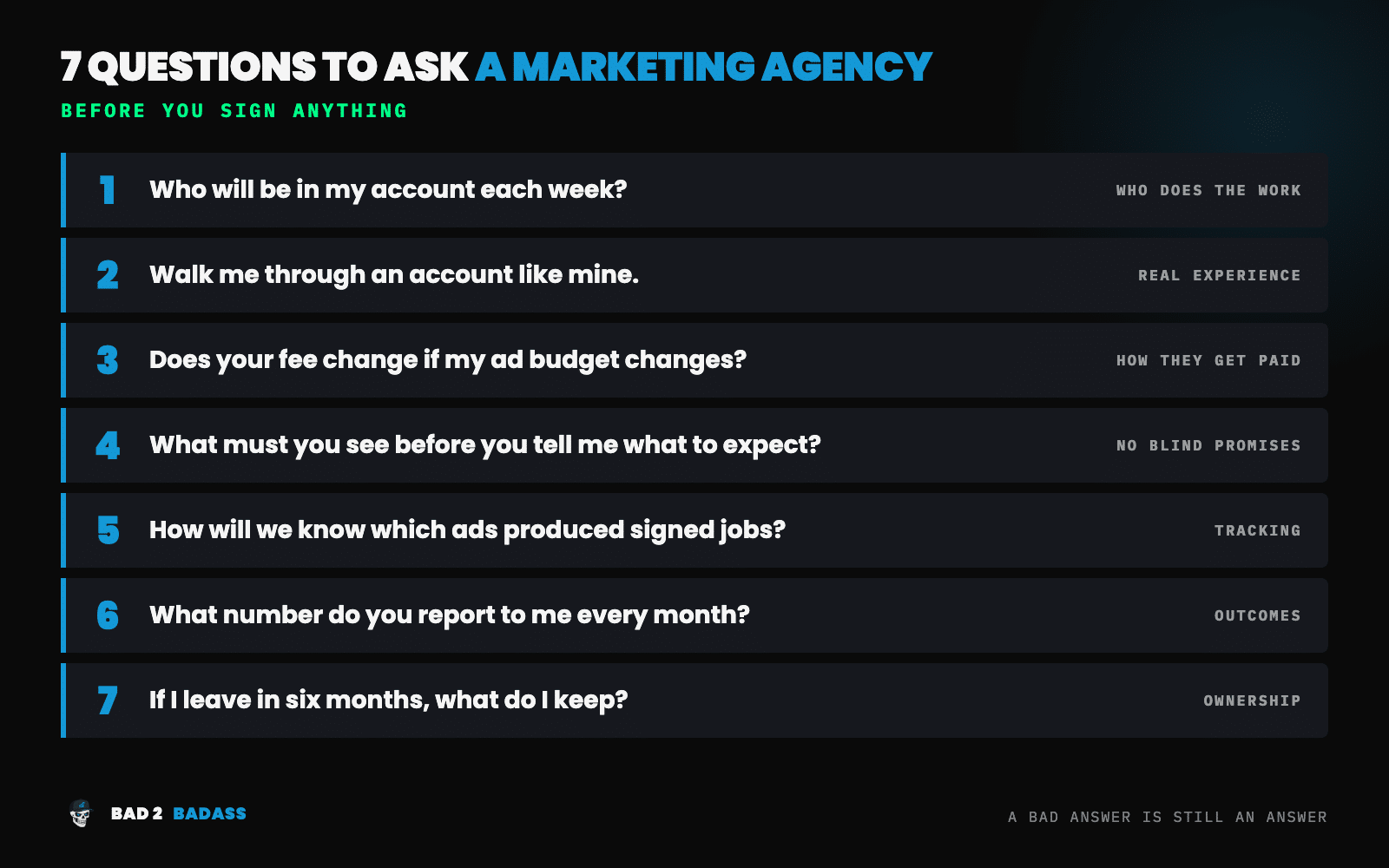
Take these into every sales call:
- Who will be in my account each week, and can I meet them before I sign?
- Walk me through a remodeling or high-ticket account you ran. What did you change first, and why?
- How is your fee set, and does it change if my ad budget changes?
- What do you need to look at before you can tell me what to expect?
- How will we know which ads produced signed jobs?
- What number do you report every month, and what do you do when it goes the wrong way?
- If I leave in six months, what do I keep?
A good marketing agency likes these questions. It has answered them before, and the answers set it apart. If you get irritation or a change of subject, treat that as the answer.
Wrapping it all up
The wrong marketing agency costs more than its fee. You also pay in months of ad spend, in estimates run for the wrong homeowners, and in the work of untangling accounts you never owned.
To recap, the 7 mistakes to avoid when hiring a marketing agency:
- Never finding out who will run your account
- Taking “we work with contractors” as experience
- Paying a fee that grows when your ad spend grows
- Believing a number promised before anyone has opened your account
- Signing before you know how a lead gets traced to a signed job
- Buying deliverables instead of outcomes
- Not owning the accounts, the data, or the exit
None of these takes expertise to avoid. Choosing a marketing agency for remodeling business growth comes down to seven questions and the willingness to walk away from a bad answer.
Want to run these questions on me?
I run paid search (Google Ads and Microsoft Ads) for remodeling companies selling $20K+ projects. You get one person in your account, a flat monthly fee, and everything built in accounts you own.
I also don’t quote results before I’ve looked. Every engagement starts with the BAD-ectomy™, a $297 diagnosis delivered in 5 business days. You get the three biggest things holding back growth, a map of where opportunities are leaking, and a 90-day plan for what to fix first. Nothing in your account gets changed, and the findings are yours whether or not we work together.
Not ready for that? Book a discovery call and bring the seven questions.