Most advice about a remodeling marketing funnel talks about awareness, content, and “nurturing.” This post takes the plainer view. A funnel is the path from a homeowner’s search to a signed job, and the only useful thing to do with it is count how many people make it through each step.
A remodeling marketing funnel is defined as: the path a homeowner takes from searching for a remodeler to signing a contract with you, measured by how many people make it from each step to the next.
In this post I cover the textbook version and what it leaves out, the five stages you can actually count, the three ways jobs get lost, and a 20-minute way to check your own numbers.
The textbook remodeling marketing funnel, and what it leaves out
The standard marketing funnel has four stages: awareness, consideration, decision, and retention. A homeowner hears of you, compares you with other contractors, picks one, and later refers a neighbor.
Nothing about that is wrong. It describes how a homeowner thinks. The trouble is that you can’t count it. Nobody can tell you how many homeowners were in “consideration” last month.
It also stops where the marketing report stops, at the lead. The form gets filled in, the report counts a win, and everything that happens afterward (the estimate, the proposal, the signature) is left out. For a company selling $20K+ projects, that back half is where the money is.
So here is the version I use. Some people call it a remodeling sales funnel, because it follows the homeowner all the way to the sale. It is the same path, counted to the end.
The 5 stages of a remodeling marketing funnel you can count
Each stage of the marketing funnel below has one job and one number. If you can write down the number, you can see the stage. If you can’t, that stage is running blind.
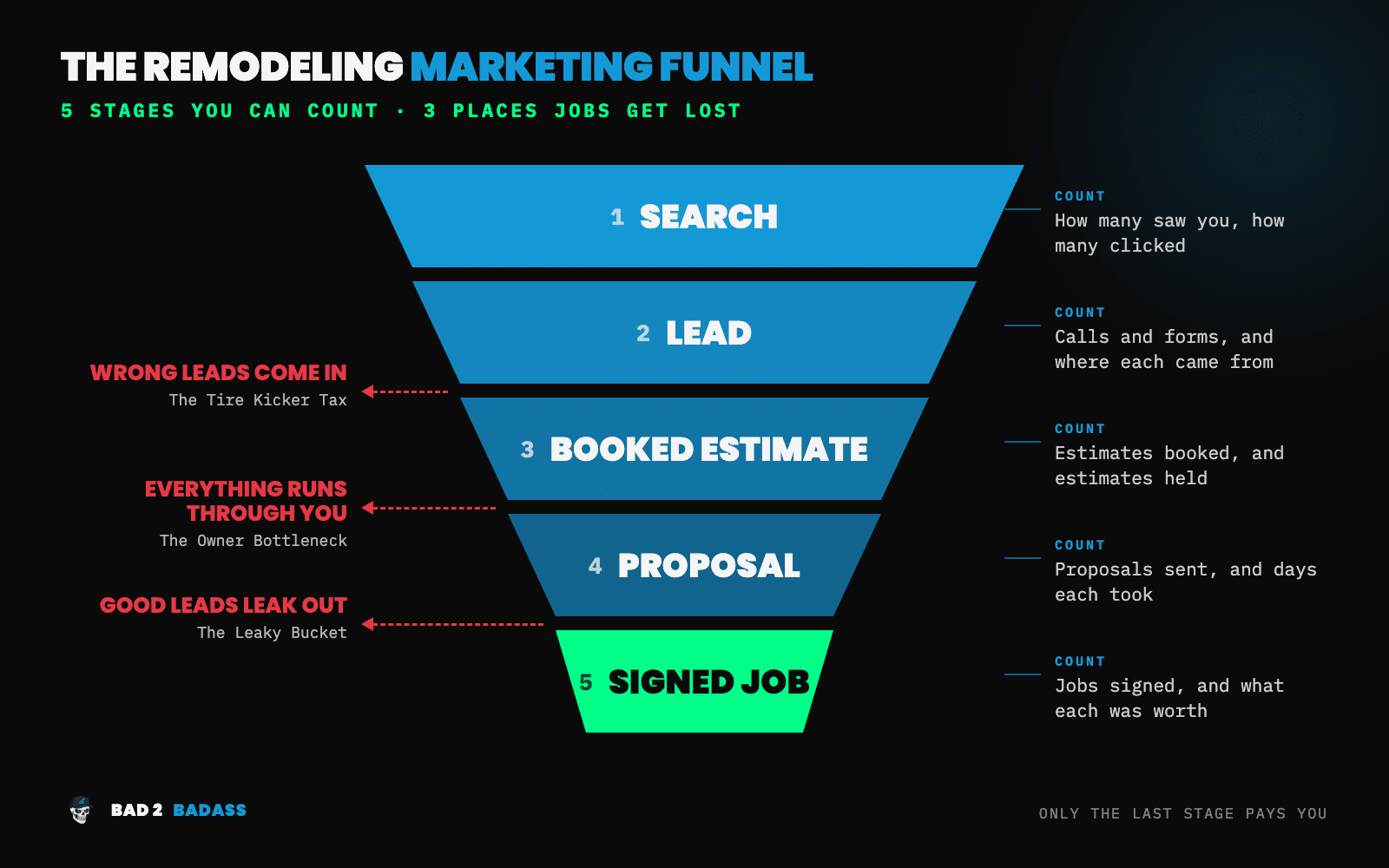
1. Search
A homeowner looks for a remodeler. They type “kitchen remodeler near me” into Google, check the map, or look up a name a neighbor gave them. Your ads, your Local Services Ads listing, and your Google Business Profile either show up at this moment or they don’t.
What you count: how many people saw you, and how many clicked.
2. Lead
The homeowner calls or fills in a form. This is the number most marketing reports are built around, and it is the easiest one to inflate. A lead can be a $90K kitchen or someone pricing a faucet swap, and the report counts them the same.
What you count: calls and forms, and where each one came from. If you can’t tell which ad produced which call, start with call tracking for your remodeling business.
3. Booked estimate
You talk to the homeowner, decide the project is real, and put an appointment on the calendar. This is the first number that tells you whether your marketing is finding the right people. I think it is the better number to judge marketing by, and I made that case in why booked consultations are the number that matters.
What you count: estimates booked, and estimates that actually happened.
4. Proposal
You visit the house, measure, and send a price. Every proposal costs you the drive, the hour at the kitchen table, and the evening spent writing it up. That is why the leads you let into this stage matter so much.
What you count: proposals sent, and how many days each one took to go out.
5. Signed job
The homeowner signs. This is the only stage that pays you, and it is the one your ad account almost never hears about.
What you count: signed jobs, what each one was worth, and which lead it started as. Your consultation close rate lives between stage 3 and stage 5.
Is a remodeling sales funnel different from a marketing funnel?
You will see both terms. In most companies, marketing owns the top (the ads, the website, the leads) and sales owns the bottom (the estimates, the proposals, the contracts).
In a remodeling company those are usually the same two or three people, and often just you. Splitting the path into a marketing half and a sales half is how the gap opens up. Marketing gets judged on leads, sales gets judged on jobs, and nobody checks whether the leads were the kind that turn into jobs.
Treat it as one marketing funnel with five stages, and count all five.
Where jobs get lost in the marketing funnel
When I look at how a remodeling company’s leads turn into work, the losses fall into three groups.
The wrong leads come in. I call this the Tire Kicker Tax. The campaigns produce leads, but too many are price shoppers, small jobs, or homeowners outside your service area. You see it between stage 2 and stage 3: plenty of calls, few worth an estimate. You pay for it twice, once in ad spend and once in your time.
Good leads leak out. This is the Leaky Bucket. Real projects come in and disappear before a contract. A call goes to voicemail while you are on a job site. A form gets answered two days later. A proposal goes out and nobody follows up. Speed matters more than most owners expect. A Harvard Business Review study of online sales leads found that companies responding within an hour were nearly seven times as likely to qualify the lead as those that waited even an hour longer.
Everything runs through you. This is the Owner Bottleneck. You answer the phone, run the estimates, write the proposals at night, and chase the follow-ups. When you get busy, proposals go out slower and fewer of them land. The funnel isn’t broken. It just can’t move faster than one person.
The order matters. Buying better leads while good ones still leak out means losing better leads the same way.
Why most remodeling marketing funnels are only measured at the top
Here is the part nobody explains to owners. Google sees the form fill the moment it happens, and counts it as the win. Whoever runs your ads reports the cost per lead, because the lead is where their piece ends. You answer for the sale, in a job tracker, a spreadsheet, or your memory, and the ad account can’t see any of those.
Nobody in that chain is doing a bad job. Each one answers for their own piece, and nobody answers for the path between them.
The result is an ad account that gets very good at finding people who fill in forms, because that is the only thing it was ever told to find. Google does let you send your sales outcomes back into the ad account, so it can learn which leads became booked estimates and signed jobs. Most remodeling accounts I look at have never had it set up.
That is what converting online remodeling leads into signed jobs comes down to. The ads have to be told which leads were worth having.
How to check your own marketing funnel in 20 minutes
You don’t need software for this. Take the last 90 days and write down four numbers:
- Leads (calls and forms)
- Estimates booked
- Proposals sent
- Jobs signed
Here is a made-up example to show how to read them. Say a company had 60 leads, 21 booked estimates, 15 proposals, and 4 signed jobs.
- 60 leads to 21 estimates. Almost two out of three leads were not worth a visit. That points at the wrong leads coming in.
- 21 estimates to 15 proposals. Six estimates never got a price. That points at time, which usually means the owner.
- 15 proposals to 4 signed. Check how fast each proposal went out, and whether anyone followed up afterward.
Find your biggest drop and start there. What each one usually calls for:
- Few leads become estimates. Either the wrong people are calling or the right ones are not getting an answer. Tighten who your ads reach (service area, the searches you pay for, what the ad says about project size), and make sure no call goes unanswered. A missed-call text-back covers the second one cheaply.
- Estimates stall before a proposal. Look at your own calendar before you look at your marketing. A faster way to price and write proposals buys back more than extra leads would.
- Proposals don’t close. Send them sooner and follow up on a schedule. Most homeowners who say “not now” are not saying no, which is why a follow-up system for “not now” leads pays for itself.
One rule of thumb: fix the stages closest to the signature first. There is no point paying for more searches and more leads while the back half of the funnel is losing the ones you already have. Your landing page and your follow-up come before more ad spend. I cover the numbers side in more depth in how to track remodeling marketing ROI.
If you can’t produce the four numbers at all, that is your answer. You have a marketing funnel. You just can’t see it.
Wrapping it all up
A remodeling marketing funnel is not a diagram for a slide. It is a count of how many homeowners made it from search to signature, and where the rest dropped out.
To recap:
- The textbook marketing funnel describes how homeowners think. It can’t be counted, and it stops at the lead.
- The version worth using has 5 stages: search, lead, booked estimate, proposal, signed job.
- Jobs get lost in three ways: the wrong leads come in, good leads leak out, and everything runs through the owner.
- Most funnels are measured only at the top, because the ad account never hears what happened after the lead.
- Four numbers from the last 90 days will show you your biggest drop.
Want to know where your remodeling marketing funnel is losing jobs?
That is what the BAD-ectomy™ is for. It is a $297 diagnosis of where your leads stop turning into jobs, delivered in 5 business days. You get the three biggest things holding back growth, a map of where opportunities are leaking, and a 90-day plan for what to fix first. Nothing in your account gets changed, and the findings are yours whether or not we work together.
Not ready for that? Book a discovery call.